
3 June 2022 Issue 2480 © ULLAPOOL NEWS
HISTORIC SUSPENSION BRIDGE REOPENS
The historic suspension bridge at spectacular Corrieshalloch Gorge in Wester Ross has reopened to visitors once again after undergoing its annual overhaul. The unique bridge, which straddles the 200ft deep gorge, was temporarily closed during May to allow routine maintenance and inspection work to be carried out. Around 140,000 people a year visit the ravine and the Falls of Measach at Braemore, south of Ullapool, which is cared for by conservation charity, the National Trust for Scotland.
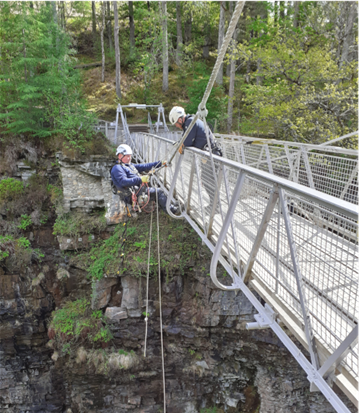
The works comprised an inspection of the bridge structure by experts as well as a geotechnical study of the rock faces around the abutments. The bridge was also given a comprehensive repaint. A firm of specialist engineering contractors were employed to carry out the job which involved abseiling off the bridge, high above the mile-long box canyon. Built around 1874 for the celebrated Victorian engineer Sir John Fowler, who helped build the Forth Rail Bridge, the suspension bridge is a feat of engineering in itself.
Martin Hughes, the Trust’s Operations Manager at Corrieshalloch Gorge and Inverewe Garden, said: “The suspension bridge over Corrieshalloch Gorge is very special and it is important to keep it in pristine condition in order that it can be enjoyed for generations to come. “This is a very exciting time for the Trust at Corrieshalloch Gorge as work continues on our new £2.3 million project which will provide improved facilities for the growing number of people who visit, while helping to conserve a much-loved site in the Highland landscape.”
The total cost of the bridge maintenance work was £10,000 – please help support us by becoming a member of the National Trust for Scotland or contributing to our online appeal.
The Corrieshalloch Gorge Gateway will create sensitively designed new visitor facilities on the site of the historical suspension bridge enabling visitors to enjoy an enhanced experience. Developments will include an outdoor coffee stop, covered outdoor seating area, toilets, Wi-Fi, a blue loo for camper vans, improved parking facilities and charging points for electric vehicles. A larger network of paths will be created, with wayfinding and interpretation around the National Nature Reserve. The £2.3 million project has secured £923,277 funding from the Natural and Cultural Heritage Fund which is led by NatureScot and funded through the European Regional Development Fund. It is part of an almost £9 million Scottish programme of projects to invest in the Highlands and Islands, to provide more and better quality opportunities for visitors to enjoy natural and cultural heritage assets.
*****
Summer Isles salmon farms gain ASC certification
Scottish Sea Farms has been awarded Aquaculture Stewardship Council (ASC) certification for its Summer Isles farms, the first time the company has achieved the coveted accreditation.
Considered one of the most demanding of all global seafood certification schemes, the target is to have up to five farms and facilities ASC certified by the end of 2022.
The ASC standard for farmed salmon was developed in collaboration with scientists, government agencies, NGOs, farmers, processors and retailers, and is underpinned by seven core principles spanning regulatory compliance, fish health, responsible use of feed and medicines, environmental interactions, employee conditions and community engagement.
For a farm to gain certification, it must be independently audited and assessed as meeting each requirement – a feat that fewer than five per cent of salmon farms in Scotland have achieved to date – and reassessed annually to maintain the ASC endorsement.
‘ASC certified farms are considered the global elite in terms of performance,’ said Scottish Sea Farms’ Aquaculture Technical Lead for ASC certification, Anna Price.
‘Gaining our first certification is the culmination of two years’ hard work, involving several different departments and functions.
‘It wasn’t that we weren’t already farming to high standards; in every instance we were. However, there was still a considerable amount of work involved in evidencing and reworking our processes and procedures.’
The three Summer Isles farms have a track record of exemplary fish health and welfare, with average survival of 94.2% across the last three crops, an average harvest weight of 6kg, and 91.7% of all fish harvested graded ‘superior’.
The farms also received an ‘excellent’ rating from the Scottish Environment Protection Agency’s CAS (compliance assessment scheme), which measures environmental performance, for the last two published years (2018 and 2019).
Farm Manager Sarah Last said: ‘The last three crops have been record-breaking for us in terms of high fish survival and low lice levels, thanks to vigilant husbandry of both salmon and cleaner fish, so there hasn’t been an overhaul of our farming approach as such.
‘Where ASC certification has been invaluable, however, is in highlighting ways in which we could hone some of our day-to-day activities even further; small changes which, when combined, could make a big difference.’
Senior Aquaculture Technical Manager Matthew James of LRQA Group, who carried out the audit, commented: ‘We were impressed both by the high level of compliance achieved at a first audit, and the knowledge and enthusiasm throughout their farming team.’
In addition to gaining certification of its first farm, Scottish Sea Farms also achieved chain of custody certification of its processing and packing facilities at South Shian near Oban – confirmation that the necessary procedures are in place to ensure that any fish that go on to carry the ASC logo are indeed from an ASC certified farm.
Work is now underway to achieve chain of custody certification for the company’s processing and packing facility in Scalloway. The next farm earmarked for certification is Lober Rock in Orkney.
Said Price: ‘ASC certification is a win-win. It gives customers further reassurance, and it gives farmers a chance to see and draw from international best practice. Going for certification of more farms can only be a good thing for all.’
*****
HISTORIC SUSPENSION BRIDGE REOPENS
The historic suspension bridge at spectacular Corrieshalloch Gorge in Wester Ross has reopened to visitors once again after undergoing its annual overhaul. The unique bridge, which straddles the 200ft deep gorge, was temporarily closed during May to allow routine maintenance and inspection work to be carried out. Around 140,000 people a year visit the ravine and the Falls of Measach at Braemore, south of Ullapool, which is cared for by conservation charity, the National Trust for Scotland.
The works comprised an inspection of the bridge structure by experts as well as a geotechnical study of the rock faces around the abutments. The bridge was also given a comprehensive repaint. A firm of specialist engineering contractors were employed to carry out the job which involved abseiling off the bridge, high above the mile-long box canyon. Built around 1874 for the celebrated Victorian engineer Sir John Fowler, who helped build the Forth Rail Bridge, the suspension bridge is a feat of engineering in itself.
Martin Hughes, the Trust’s Operations Manager at Corrieshalloch Gorge and Inverewe Garden, said: “The suspension bridge over Corrieshalloch Gorge is very special and it is important to keep it in pristine condition in order that it can be enjoyed for generations to come. “This is a very exciting time for the Trust at Corrieshalloch Gorge as work continues on our new £2.3 million project which will provide improved facilities for the growing number of people who visit, while helping to conserve a much-loved site in the Highland landscape.”
The total cost of the bridge maintenance work was £10,000 – please help support us by becoming a member of the National Trust for Scotland or contributing to our online appeal.
The Corrieshalloch Gorge Gateway will create sensitively designed new visitor facilities on the site of the historical suspension bridge enabling visitors to enjoy an enhanced experience. Developments will include an outdoor coffee stop, covered outdoor seating area, toilets, Wi-Fi, a blue loo for camper vans, improved parking facilities and charging points for electric vehicles. A larger network of paths will be created, with wayfinding and interpretation around the National Nature Reserve. The £2.3 million project has secured £923,277 funding from the Natural and Cultural Heritage Fund which is led by NatureScot and funded through the European Regional Development Fund. It is part of an almost £9 million Scottish programme of projects to invest in the Highlands and Islands, to provide more and better quality opportunities for visitors to enjoy natural and cultural heritage assets.
*****
Summer Isles salmon farms gain ASC certification
Scottish Sea Farms has been awarded Aquaculture Stewardship Council (ASC) certification for its Summer Isles farms, the first time the company has achieved the coveted accreditation.
Considered one of the most demanding of all global seafood certification schemes, the target is to have up to five farms and facilities ASC certified by the end of 2022.
The ASC standard for farmed salmon was developed in collaboration with scientists, government agencies, NGOs, farmers, processors and retailers, and is underpinned by seven core principles spanning regulatory compliance, fish health, responsible use of feed and medicines, environmental interactions, employee conditions and community engagement.
For a farm to gain certification, it must be independently audited and assessed as meeting each requirement – a feat that fewer than five per cent of salmon farms in Scotland have achieved to date – and reassessed annually to maintain the ASC endorsement.
‘ASC certified farms are considered the global elite in terms of performance,’ said Scottish Sea Farms’ Aquaculture Technical Lead for ASC certification, Anna Price.
‘Gaining our first certification is the culmination of two years’ hard work, involving several different departments and functions.
‘It wasn’t that we weren’t already farming to high standards; in every instance we were. However, there was still a considerable amount of work involved in evidencing and reworking our processes and procedures.’
The three Summer Isles farms have a track record of exemplary fish health and welfare, with average survival of 94.2% across the last three crops, an average harvest weight of 6kg, and 91.7% of all fish harvested graded ‘superior’.
The farms also received an ‘excellent’ rating from the Scottish Environment Protection Agency’s CAS (compliance assessment scheme), which measures environmental performance, for the last two published years (2018 and 2019).
Farm Manager Sarah Last said: ‘The last three crops have been record-breaking for us in terms of high fish survival and low lice levels, thanks to vigilant husbandry of both salmon and cleaner fish, so there hasn’t been an overhaul of our farming approach as such.
‘Where ASC certification has been invaluable, however, is in highlighting ways in which we could hone some of our day-to-day activities even further; small changes which, when combined, could make a big difference.’
Senior Aquaculture Technical Manager Matthew James of LRQA Group, who carried out the audit, commented: ‘We were impressed both by the high level of compliance achieved at a first audit, and the knowledge and enthusiasm throughout their farming team.’
In addition to gaining certification of its first farm, Scottish Sea Farms also achieved chain of custody certification of its processing and packing facilities at South Shian near Oban – confirmation that the necessary procedures are in place to ensure that any fish that go on to carry the ASC logo are indeed from an ASC certified farm.
Work is now underway to achieve chain of custody certification for the company’s processing and packing facility in Scalloway. The next farm earmarked for certification is Lober Rock in Orkney.
Said Price: ‘ASC certification is a win-win. It gives customers further reassurance, and it gives farmers a chance to see and draw from international best practice. Going for certification of more farms can only be a good thing for all.’
*****